





Word Search Puzzle Game Tips for Beginners
New word search and word find puzzles look simple—until half the list still hides after ten minutes of random peeking. The tips below help you build steady habits on straight-line grids from day one, not crossword-style clue solving.
Start With a Systematic Scanning Method
The fastest upgrade for beginners is replacing wandering eyes with a scan path you repeat every puzzle.
Instead of darting around, try:
- Row passes from top to bottom, covering each band before you move on
- Column passes left to right when horizontal sweeps stall
- Finishing one direction across a section before you open another angle
That order cuts double work and leaves fewer blind spots in busy corners of the grid.
Look for Unusual Letter Shapes First
Some letter combinations stand out against filler noise.
Watch for:
- Uncommon letters such as Q, Z, and X
- Double letters or tight clusters that match list spellings
- Short runs that break up otherwise random-looking rows
Those spots often sit on or beside full list words along the same straight path.
Search for the First Letter of Each Word
Pick one list entry at a time: hunt its opening letter (or its rarest letter), then trace every allowed direction from that cell.
For example, when the word is APPLE, search for A, explore each legal line from every A you see, and confirm spelling cell by cell before you mark. The same habit scales when grids grow larger.
Don't Forget Reverse Directions
Many beginner misses come from reading only left-to-right or top-to-bottom.
To catch backward spellings when rules allow them:
- Run the same row or column in both directions on each pass
- Check upward from a promising letter, not only downward
- Notice mirrored runs that look wrong until you read them in reverse
A quick reverse check on each band often unlocks words you already crossed.
Use Diagonal Scanning Early
Diagonal words frustrate players who save slants for last. Weave diagonal sweeps in from the start—top-left to bottom-right and top-right to bottom-left—using the same steady pacing you use for rows and columns.
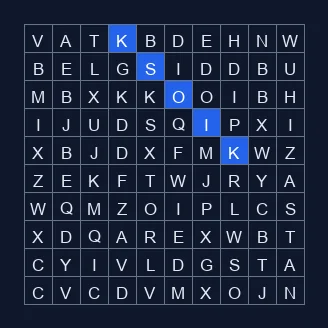
One highlighted diagonal path shows a hidden word as a single straight line through adjacent cells. Training on slants early makes later diagonal passes feel familiar instead of like a separate puzzle.
Focus on both diagonal slopes when your puzzle rules include them; skipping them until the end usually means extra full-grid sweeps.
Take Advantage of Word Length
Length is free information from the word list.
Beginners often do well when they:
- Find longer words first when they stand out—they span more cells and simplify what remains
- Save very short entries for a closing sweep
- Use each landed long word to spot neighbors that share letters on the grid
Avoid Random Guessing
Guessing without proof wastes marks and attention.
Instead:
- Confirm every cell on the path before you highlight or strike through
- Match the spelling to the list entry exactly
- Reset when a path fails halfway instead of forcing a near-miss
Letter-by-letter confirmation beats hopeful clicking.
Mark Found Words Clearly
Knowing what is already solved keeps effort on what is left.
Depending on the format:
- Circle or underline the full path on printed puzzles
- Use in-game selection or list strike-through in digital word search games
- Avoid leaving found words unmarked—you will rescan the same cells
Clear marks make the remaining list honest and your progress visible.
Stay Relaxed and Patient
Word search puzzle games stay enjoyable when pace stays calm.
A steady rhythm supports pattern focus, fewer missed overlaps, and a scan order you can repeat. Rushing usually means overlooked bands and repeat passes over areas you already solved.
Practice Builds Pattern Recognition
The simplest long-term tip is regular play: the more grids you finish with one scan method, the faster common shapes register.
With practice in word search puzzle games, you naturally pick up:
- Faster recognition of word silhouettes
- Better sense of how words sit in the grid
- Quicker spotting of hidden straight paths
What once felt crowded starts to feel readable.
Frequently Asked Questions
Should beginners start with long words or short words?
Longer entries often anchor a board when they are distinctive; short words need tighter passes. Many players clear a few longer or eye-catching spellings first, then mop up short words on a thinner grid.
Do I need to check every direction on every pass?
Learn what your puzzle allows, then cover each direction family in order—rows, columns, diagonals, and reverses as permitted. One finished pass per direction beats scattering every orientation into a single chaotic glance.
What is the most common beginner mistake?
Random scanning without marking finds—or camping on one stubborn word while the rest of the grid waits. A repeatable sweep plus clear marks fixes most early frustration.
Are word search tips different from crossword tips?
Yes. Word search and word find play means tracing complete words along straight paths in a letter grid from a list, not filling blanks from definitions. These tips target scanning and marking in that format.