





Word Search Puzzles in Education
Word search and word find puzzles show up in classrooms, homework packets, and online study breaks for a reason: the setup is simple (a letter grid, a word list, straight paths through filler letters), yet students get repeated contact with lesson vocabulary without the stress of cold recall or crossword-style clue solving.
Teachers treat them as a supplement—not a substitute for direct instruction—when they want spelling exposure, visual scanning practice, and a low-friction activity students can start on their own.
Why Word Search Puzzle Games Are Used in Education
Educators reach for word search puzzle games when a lesson needs light reinforcement rather than a new concept dump.
Reinforcing Classroom Vocabulary
Themed lists align grids with what the unit is already teaching.
- Students meet target spellings several times in one sitting
- Repetition builds recognition faster than a single read-through
- Subject-specific sets keep terms tied to science, history, language arts, or other goals
That rhythm helps especially in language learning and terminology-heavy courses.
Supporting Active Learning
Searching turns passive vocabulary sheets into a task.
- Learners hunt spellings instead of only copying lists
- Attention splits between letter order and word shape
- The work feels like play while still targeting reading and spelling skills
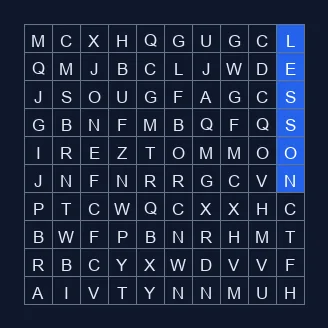
A vertical highlight on a classroom-style grid shows the core loop: the list names a target (“LESSON” here), the student traces matching letters through noise, and moves on—recognition and spelling check in one pass.
Educational Benefits of Word Search Puzzle Games
Beyond vocabulary lists, the format trains habits that support other schoolwork.
Improving Concentration Skills
Finding every list item requires sustained scanning.
- Students practice holding attention on one strip of the grid
- Careless passes show up quickly as “missing” words
- Patience builds when layouts get denser or directions multiply (per puzzle rules)
Enhancing Visual Processing
The board is a field of letter patterns, not isolated flashcard faces.
- Learners notice how the same spelling looks in different orientations
- Repeated letter pairs and prefixes stand out across rows and columns
- Visual memory gets another anchor besides hearing a word once in lecture
Encouraging Independent Learning
Rules are easy to explain, so word search puzzle games work for centers, early finishers, or home practice.
- Minimal teacher setup once the list exists
- Students self-pace without oral performance pressure
- Confidence grows when they complete a full grid solo
Role of Word Search Puzzles in Different Subjects
The same mechanic adapts across the curriculum when the word list changes.
Language and Literacy
- Vocabulary from current texts or spelling units
- Letter-order practice for emerging readers
- Sight-word reinforcement in larger primary grids
Science and Geography
- Lab equipment, biomes, or body-system terms
- Planet, weather, and nature vocabulary
- Place names, landforms, and map-related concepts
History and Social Studies
- Key figures, events, and era labels
- Cultural and civic vocabulary
- Dates and movements as short, searchable tokens
Matching the list to standards keeps the puzzle aligned with what the class will assess later—not random entertainment.
How Teachers Use Word Search Puzzle Games in Class
Common placements keep the activity purposeful.
Warm-Up Activities
- Preview a unit’s word bank before lecture
- Activate prior knowledge on a returning topic
- Settle the room with a quiet, visual task
Review Exercises
- Recycle terms after a chapter or lab
- Check whether spellings are familiar before a quiz
- Mix easy wins with a few longer entries for differentiation
Homework Assignments
- Independent practice with clear stopping points
- Low-stakes repetition outside class time
- Optional parent involvement for younger grades
Pair grids with a quick meaning check or sentence task so recognition does not float without context.
Difficulty Levels in Educational Word Search Games
Age and skill level map to grid design choices.
Beginner Level
- Smaller boards and high-frequency words
- Fewer directions if your edition allows simplified rules
- Plenty of whitespace so paths are easy to trace
Intermediate Level
- Larger grids and tighter themed sets
- More overlap between words on the board
- Mixed straight paths that still follow list-and-line rules
Advanced Level
- Dense fills and longer multi-syllable terms
- Harder placements that reward systematic scanning
- Timed rounds only when students already trust the format
Challenges and Limitations in Educational Use
Word search puzzle games excel at recognition; they do not teach deep meaning by themselves.
- Students may spot a spelling without knowing how to use the word in speech or writing
- Overuse without variety can feel like busywork
- Assessment value is narrow compared with production tasks or written explanations
Use them beside reading, discussion, writing prompts, and explicit vocabulary instruction.
Why Word Search Puzzles Remain Popular in Education
They stay popular because they are quick to print or assign, easy to differentiate by list and size, and familiar to parents and substitute teachers.
The balance of structure, repetition, and light engagement keeps them in toolkits from elementary literacy through secondary subject review—especially when themed word search puzzle games mirror what the unit already covers.
Frequently Asked Questions
Can word search puzzles replace a vocabulary lesson?
No. They reinforce spellings and visual recognition well. Definitions, usage, reading in context, and speaking still need direct teaching and richer tasks beyond the grid.
Are word search games fair for students with reading difficulties?
They can help or frustrate depending on list length, grid density, and time pressure. Shorter lists, larger type, untimed sessions, and allowed partner checks make the format more accessible.
Should teachers always provide a word list?
For classroom use, yes—list-and-line word search puzzle games assume learners know what to hunt. List-free variants exist but shift the goal toward discovery rather than targeted lesson vocabulary.
How often should word search appear in a unit plan?
Sprinkle them as warm-ups, reviews, or light homework—not daily for every objective. Rotate with discussions, labs, writing, and other practice so recognition work does not crowd out meaning.
Where can educators find themed grids for classroom topics?
Many teachers build lists from unit glossaries or textbook appendices. For ready-made themed word search puzzle games online, word-search-puzzles.com groups puzzles by topic so you can match a grid to a lesson without building every list from scratch.